Showing posts with label journalism. Show all posts

Wednesday, February 24, 2010

Could Woodward/Bernstein Happen Today? (The State of Media)


I rewatched one of my favorite films today, All The President's Men. Being a journalist, it helped inspire me to be in this field just seeing how Bob Woodward and Carl Bernstein were diligent about doing the right thing and finding the truth. It's the essence of what being a reporter is about - telling stories and telling the truth.

The movie itself is faithful to the original story. It teaches a lot about how the newspaper biz works - the young, eager reporters working to get a story, the dogged editor-in-chief who slowly gives them support (Jason Robards owns this Oscar-winning role as the legendary Ben Bradlee - before this movie I only knew Robards as the grandfather on Heidi), and ultimately the power of the press to serve the people and check those in positions of authority.

Robert Redford and Dustin Hoffman do a great job playing off each other as total opposites yet united in a common goal. The camera work is incredible with the heavy light inside the newsroom and nowhere else, the long shots when they are in the library and driving through the city. Washington D.C. is as much a character in that movie as anybody.

"Follow the money" - a classic quote that to me describes the best way to find the truth about something.

Just like Good Night and Good Luck, it's one of the best movies about the business that I've seen. And at times when I feel like journalism is short on inspiration, it reminded me why I do this.

But it made me wonder if the Watergate stories could happen in today's media climate. A major national story carried by one paper that put the pressure on the government. No.
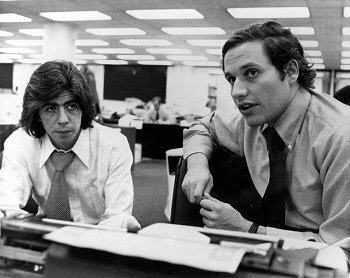

(Bernstein and Woodward - real American heroes. Ironically, Bernstein left the Post before the 70's ended and is now a CNN contributor and Woodward went on to be one of most celebrated reporters of our age)

In the era of partisan criticism and bloggers, any major story would be under heavy scrutiny. The paper running the story would need a combo of strong reporting, solid editors to help guide them and protect them, publishers and owners who wouldn't succumb to financial pressure and support the editorial direction. They also would need a lot of luck.

Cable news would most likely be the source of a hard-hitting investigative piece but because there is so much news and so many distractions, it'll be hard to keep the focus of the American public on any issue. Just look at the debate on health care being pushed to the back burner.

What I know for sure is that there's no chance Deep Throat would stay a secret for 30+ years. To quote my favorite LA band of the moment, Silversun Pickups, "There's no secrets this year" - and in this era of TMZ and tabloids, its hard for anything to stay hidden. Consider how Tiger Woods' secret affairs stayed a secret for several years apparently but unraveled faster than Usain Bolt.

Not to mention the decline of newspapers around the country makes investing in hard-hitting stories a lot harder. You have people who own papers who are more concerned about the money and advertising than the product. I've seen it firsthand and it often means that newsrooms can't engage in the type of reporting needed for those kind of stories.

To me, the movie represents a watershed moment of journalism and the times (any surprise that Walter Cronkite is one of my role models?). Not to mention an era of filmmaking that took chances and was more about art and storytelling than public tastes. It's a shame neither happen again more often.

Monday, July 20, 2009

Walter Cronkite - An American Original and Personal Role Model


I always knew I’d feel sad when Walter Cronkite died. As I saw him age, I knew it would happen and yet now that is has happened, Friday was definitely a sad day for journalism and America.

Anyone who knows anything about journalism knows that two names loom larger than anybody in the development of this business: Edward R. Murrow and Cronkite. Murrow was the father of modern-day reporting, a no-nonsense style that catered toward giving the facts and telling the truth. Cronkite was part of the next generation – Murrow’s handpicked successor who birthed the modern-day TV newsanchor while never losing the essence of being a reporter.

I admired him because he didn’t want to be bigger than the story. He was from a school of reporting that every journalism junkie should be – get the facts and tell it straight, no chaser. Travel to wherever the story is. And most of all, while being detached, don’t be afraid to empathize with the viewer when appropriate.

His voice was reassuring and he reminded folks of a grandfatherly figure who sought to earn your trust. The label “Most Trusted Man in America” was something he earned night in, night out and in an era of 3 TV networks, he succeeded.


One defining moment was November 22, 1963 . The way he announced President Kennedy’s death was emotional, yet restrained. Just watch that still shot before you watch this video around the 3:18 mark. Glasses slowly removed, pain on his face, words halting. A moving site that defined a nation's pain.

And yet it was reassuring, the calming presence a nation needed in explosive grief yet I wondered what Cronkite thought that day. His reaction would influence anchors on future days of sadness. Think Jim McKay after the Munich Olympics massacre, Peter Jennings after 9/11, Anderson Cooper after Hurricane Katrina – all of them learned how to report difficult circumstances after Cronkite.

Another defining moment came five years later when he called the Vietnam war a “stalemate.” I remember hearing that in a history class at USD and it pretty much said what most thought during that tumultuous year. I love it because it combined journalism with anchor commentary - Cronkite went to Vietnam a few times during the Tet offensive and saw events firsthand through his reporting, leading him to make his famous assertion.

40 years ago today, he displayed great joy over the moon landing. He was a dogged reporter who knew how to enjoy himself.

My regret is that I was born three years after he stepped down in 1981. But he stayed visible – a living monument to the future of what we should aspire to regardless of profession.


He, along with Bob Woodward and Carl Bernstein and others, inspired me to be a reporter. That voice, that straightforwardness, that presence of knowing what he was talking about, that uncompromising spirit. He was an American original that we’ll never see again. Even after his retirement, he proved to be a sound critic of journalism – particularly the expansion of the media eliminating the need to get facts right or find news to capture our attention 24/7.

Cronkite was about the truth. The unfiltered truth. He told his staff to be a mirror reflecting the news of the day. There’s a time for news and a time for opinion and he helped establish that now blurred line. Thank you, Mr. Cronkite, for your service and your far-reaching influence on our media. You get the last word just like you did 28 years ago.

“Old anchormen, you see, don't fade away; they just keep coming back for more. And that's the way it is: Friday, March 6, 1981” – his last night in the chair.